
How Conversational Intent Detection Works In B2B Sales
- Elizabeth Christopher
- May 20
- 5 min read
If Human AI can engage buyers in real time, qualify intent, and route validated opportunities to human reps, one critical question follows:
How does it actually know the difference between a serious buyer and a curious visitor?
The answer is conversational intent detection, and it changes everything.

Why Behavioral Detection Fails at the Critical Moment
91% of B2B marketers now use intent data to prioritize accounts, and the intent data market has grown to $4.49 billion in 2026. The investment is real. The problem is what it is being invested in.
Behavioral intent data answers one question well: who might be interested? For top-of-funnel awareness, that information has value. But 70% of the B2B buying journey happens anonymously in what analysts call the Dark Funnel - research activity that no behavioral tracking tool can see.
By the time a prospect surfaces in your system and begins generating behavioral signals, 92% of B2B buyers already have at least one vendor in mind, and 41% have already selected a preferred vendor.
Behavioral data tells you someone showed up. It cannot tell you where they are in their decision, or whether they have already made one, and that is the gap conversational intent detection was built to close.
What Conversational Intent Detection in B2B Actually Is
Conversational intent detection is the process of revealing purchase readiness through direct dialogue. Not inferred from clicks. Not scored from page visits. Discovered through questions, responses, and real-time context that no behavioral signal can capture.
Where behavioral data observes, conversational detection asks. The answers reveal what observation never could: urgency, authority, budget reality, competitive context, and decision criteria. The variables that actually predict whether a deal will close.
Conversational AI qualifies buyers by analyzing responses, intent, engagement patterns, sentiment, and predefined criteria such as budget, use case, and readiness to buy, in real time, across a live dialogue that adapts to every response.
How It Works: The Five Signals a Conversation Reveals
Every intentional conversation surfaces five variables that behavioral data structurally cannot detect:
Urgency: is the buyer operating against a real timeline or exploring theoretically? A direct question — "What does your timeline look like for making a decision?" — produces an answer that changes everything about how the conversation proceeds. A behavioral signal cannot make that distinction.
Authority: is this person part of the decision or peripheral to it? Content engagement tracks whoever clicked the link, not whether that person influences the purchase. "Who else is involved in evaluating this?" reveals the buying committee structure in a single exchange.
Budget reality: Is there allocated resource or theoretical interest? A pricing page visit indicates curiosity. A direct question confirms whether a budget conversation has happened internally, and whether this is a live opportunity or a research exercise.
Competitive context: Are they evaluating alternatives or gathering market intelligence? "Are you currently evaluating other solutions?" produces context that shapes everything that follows. Behavioral data is blind to this entirely.
Decision criteria: What does the buyer need to see to move forward? This is the most valuable signal in any sales conversation, and the one behavioral data cannot touch. Direct dialogue surfaces the specific conditions a buyer requires before committing. That intelligence transforms how the solution is presented.
What the Conversation Actually Looks Like
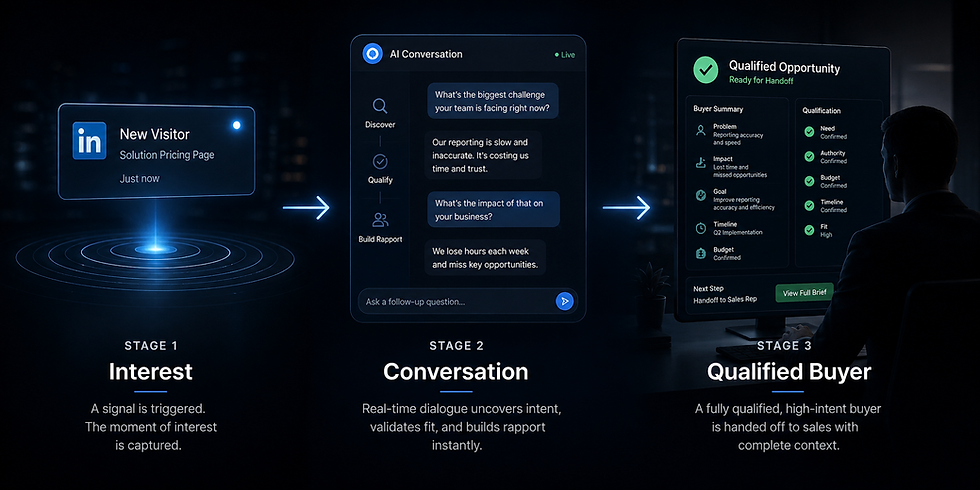
Consider a prospect who clicks a personalized campaign link for an enterprise solution. The conversation begins instantly.
The AI opens with a discovery question: "What's the biggest challenge your team is currently facing with your sales process?"
The prospect responds: "We're losing deals because our follow-up is too slow. By the time our SDRs reach out, the prospect has already moved on."
That single response reveals urgency: there is an active, painful problem. It confirms the buyer understands the issue. And it maps directly to the solution being offered.
The conversation continues: "How quickly does that typically happen — days or hours?"
"Usually within 24 to 48 hours. We've tracked it in our CRM."
Now the conversation has surfaced specific data, confirmed the buyer has analyzed the problem, and revealed they are solution-aware. This is not a curious visitor. This is a buyer with a defined need, an active problem, and the organizational awareness to have tracked it.
The intent signals that matter most happen in discovery conversations, solution walkthroughs, and qualification exchanges, not in anonymous browsing activity. Conversational detection captures those signals at the earliest possible moment, before they disappear into a queue or age out of relevance.
Why Context Is the Variable That Changes Everything
The same question asked of two different prospects produces two entirely different intent signals, depending on context.
A VP of Sales at a 200-person SaaS company saying "we need to fix our follow-up speed" is a fundamentally different buying signal than a Marketing Coordinator at a 15-person startup saying the same thing. Same words. Different authority. Different budget. Different decision timeline.
Conversational detection reads context in real time. Company size, role, current process, specific pain points, and competitive situation all emerge through dialogue, and each piece of context changes the intent signal it generates.
96% of consumers are more likely to buy from brands that personalize experiences, while 81% ignore generic messages entirely. Conversational detection is what makes genuine personalization possible at scale. The dialogue does not follow a fixed script. It responds to what the buyer actually says, surfacing intent signals that are specific, contextual, and actionable.
From Detection to Decision
Conversational intent detection does not stop at qualification. In a full revenue motion, it advances the conversation, presenting the solution, handling objections in real time, and moving the buyer toward a decision.
Deloitte reports that predictive systems applied to live buyer conversations can lift conversion by more than 40% when deployed across the full acquisition and engagement cycle.
The dialogue is not a handoff mechanism. It is a revenue mechanism.
That is the distinction that separates conversational intent detection from every behavioral tool that came before it. It does not just identify buyers. It moves qualified buyers toward a decision in real time.
Conversational Intent Detection: The Engine Behind the Results
The most forward-thinking B2B SaaS companies are already deploying conversational intent detection not as a supplement to their existing GTM motion, but as the foundation of a new one.
MYai Sells was built around conversational intent detection as its core capability. Its Human AI engages buyers instantly, discovers needs, delivers real-time presentations with slides and video, handles objections, and closes deals, while intelligently escalating complex opportunities to your human reps.
The result is not better leads. It is ready-to-buy customers delivered directly to your business.
If conversational intent detection can identify serious buyers and move them toward a decision in real time, the next question becomes even more important: what happens when Human AI does not stop at qualification, but handles the entire sales presentation, objection handling, and close itself?


Comments